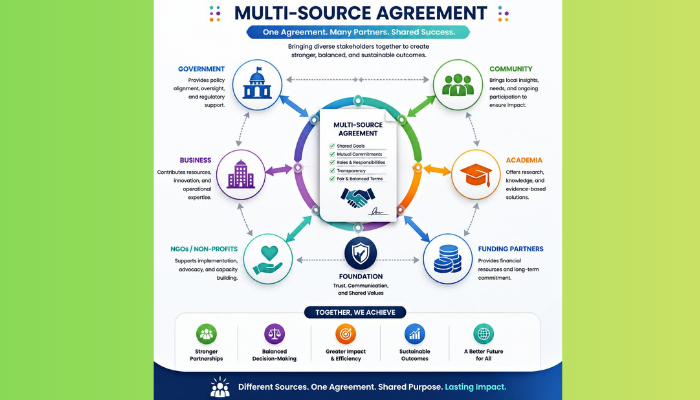

Have you ever wondered how large organizations manage to coordinate agreements with multiple partners simultaneously? The answer lies in multi-source agreement, a strategic approach that has revolutionized the way businesses handle collaborative contracts and partnerships.
In today’s interconnected business landscape, companies rarely operate in isolation. They work with suppliers, vendors, service providers, and strategic partners to deliver value to their customers. Multi-source agreement provides the framework that makes these complex relationships manageable, efficient, and mutually beneficial.
What Exactly Is Multi-Source Agreement?
At its core, a multi-source agreement is a contractual arrangement that involves three or more parties working together toward common objectives. Unlike traditional bilateral contracts between two parties, these agreements coordinate the responsibilities, obligations, and benefits among multiple stakeholders.
Think of it as orchestrating a symphony rather than a duet. Each party plays a specific role, and the agreement ensures everyone performs in harmony to create the desired outcome.
The Evolution of Multi-Party Contracts
Business agreements have come a long way from simple handshake deals. As supply chains grew more complex and projects became more ambitious, the need for sophisticated multi-party arrangements became apparent.
The construction industry was among the first to widely adopt multi-source agreements. Building a skyscraper requires architects, engineers, contractors, subcontractors, suppliers, and financiers to work together seamlessly. Without a comprehensive agreement structure, such projects would collapse under the weight of conflicting interests and miscommunication.
Key Components of Effective Multi-Source Agreements
Creating a successful multi-source agreement requires careful attention to several critical elements. Let me walk you through each component that makes these agreements work.
Clear Role Definition
Every party must understand exactly what they bring to the table. Ambiguity is the enemy of successful collaboration. The agreement should specify who does what, when they do it, and to what standard.
For example, in a technology implementation project, one vendor might provide software, another handles integration, a third manages training, and the client organization provides subject matter experts. Each role must be clearly delineated.
Responsibility Allocation
Beyond defining roles, the agreement must allocate specific responsibilities. This goes deeper than job descriptions. It includes decision-making authority, approval processes, and escalation procedures.
Who has the final say when disagreements arise? What happens if one party fails to meet their obligations? These questions must be answered upfront.
Performance Metrics and Standards
How will success be measured? Multi-source agreements thrive when everyone understands the benchmarks they need to meet. These metrics should be objective, measurable, and aligned with the overall project goals.
Setting clear standards prevents disputes and creates accountability across all parties involved.
Communication Protocols
With multiple parties involved, communication can quickly become chaotic. Effective multi-source agreements establish communication channels, reporting requirements, meeting schedules, and documentation standards.
Regular touchpoints keep everyone aligned and allow for early identification of potential issues before they escalate.
Dispute Resolution Mechanisms
Even with the best planning, disagreements happen. Smart multi-source agreements include predetermined dispute resolution processes that allow parties to resolve conflicts without destroying the collaborative relationship.
Mediation, arbitration, and tiered escalation procedures can save time, money, and partnerships when tensions arise.
Types of Multi-Source Agreements
Multi-source agreements come in various forms, each suited to different business contexts and objectives. Understanding these types helps you choose the right structure for your needs.
Consortium Agreements
These agreements bring together multiple organizations to pursue a common goal that none could achieve alone. Research and development consortiums, for instance, pool resources and expertise to advance innovation in their field.
Universities, corporations, and government agencies often form consortiums to tackle complex challenges like climate change, medical research, or technology development.
Joint Venture Agreements
When two or more parties want to create a new business entity together, they enter into joint venture agreements. Each party contributes resources, shares risks and rewards, and participates in management according to the agreed terms.
Joint ventures are particularly popular in international business, where local knowledge combines with foreign capital and expertise.
Supply Chain Agreements
Modern supply chains involve numerous parties working in coordination. Multi-source supply chain agreements ensure smooth flow of materials, information, and payments across the entire network.
These agreements might cover everything from raw material suppliers to manufacturers, distributors, logistics providers, and retailers.
Service Level Agreements (SLAs)
When multiple service providers support a single client, coordinated SLAs ensure seamless service delivery. Each provider commits to specific performance standards, and the agreements specify how the services integrate.
IT outsourcing frequently uses this model, with different vendors handling infrastructure, applications, security, and support.
Partnership Agreements
Strategic partnerships often involve more than two parties. These agreements govern how organizations collaborate on marketing, product development, market expansion, or other strategic initiatives.
The key is ensuring all partners benefit fairly from the arrangement while contributing their unique strengths.
Benefits of Multi-Source Agreements
Why go through the complexity of coordinating multiple parties? The benefits often outweigh the challenges significantly.
Risk Distribution
Instead of one party bearing all the risk, multi-source agreements spread it across multiple stakeholders. This makes ambitious projects more feasible and protects individual parties from catastrophic losses.
In real estate development, for example, distributing financial risk among investors, lenders, and developers makes large projects possible without exposing any single party to excessive danger.
Resource Pooling
Multi-source agreements allow parties to combine their resources, creating capabilities that exceed what any individual participant could muster alone. This includes financial resources, expertise, technology, networks, and market access.
Small businesses can compete with larger rivals by forming strategic alliances that pool their collective strengths.
Innovation Acceleration
When diverse expertise comes together, innovation flourishes. Multi-source agreements create environments where different perspectives, skills, and knowledge bases intersect, often leading to breakthrough solutions.
The most exciting innovations in fields like biotechnology, renewable energy, and artificial intelligence typically emerge from collaborative efforts.
Market Access and Expansion
Entering new markets is expensive and risky. Multi-source agreements with local partners provide market knowledge, established relationships, and regulatory expertise that accelerate expansion while reducing risk.
International businesses rely heavily on these arrangements to navigate unfamiliar territories successfully.
Cost Efficiency
Sharing costs across multiple parties makes expensive undertakings more affordable for everyone. Infrastructure projects, research initiatives, and technology development all benefit from distributed investment.
The cost savings can be substantial, making projects viable that would be prohibitively expensive for a single organization.
Challenges in Multi-Source Agreements
Despite their benefits, these agreements come with inherent challenges that require careful management.
Coordination Complexity
The more parties involved, the harder it becomes to coordinate activities, align schedules, and maintain momentum. What seems simple with two parties becomes exponentially more complex with five or ten.
Project management becomes critical, requiring dedicated resources to keep everyone synchronized.
Conflicting Interests
Each party brings their own objectives, priorities, and constraints. Aligning these diverse interests requires skillful negotiation and sometimes creative compromise.
The challenge intensifies when business conditions change and parties need to renegotiate terms while keeping the agreement intact.
Communication Barriers
Different organizational cultures, communication styles, technical languages, and even time zones can create misunderstandings. What one party considers urgent, another might view as routine.
Overcoming these barriers requires intentional communication strategies and cultural sensitivity.
Decision-Making Delays
When multiple approvals are required, decision-making slows down. This can be frustrating in fast-moving situations that demand quick responses.
Effective multi-source agreements establish clear decision-making authority to minimize unnecessary delays while maintaining appropriate oversight.
Unequal Contribution or Benefit
Perceived or actual imbalances in contribution or benefit can create resentment and threaten the agreement’s stability. If one party feels they are doing more work or receiving less value, conflicts inevitably arise.
Regular reviews and transparent accounting help maintain equity and trust.
Best Practices for Creating Multi-Source Agreements
Drawing from decades of business experience, certain practices consistently lead to more successful multi-source agreements.
Start with Alignment
Before drafting contracts, ensure all potential parties share compatible visions, values, and objectives. Misalignment at the foundational level dooms even the best-written agreements.
Invest time in exploratory discussions, joint planning sessions, and relationship-building before committing to formal arrangements.
Engage Legal Expertise Early
Multi-source agreements involve complex legal considerations across multiple jurisdictions, regulatory frameworks, and liability concerns. Experienced legal counsel should be involved from the beginning, not as an afterthought.
The investment in quality legal advice pays dividends by preventing disputes and ensuring enforceability.
Design for Flexibility
Business conditions change. Technology evolves. Markets shift. Your agreement should accommodate reasonable adaptations without requiring complete renegotiation.
Built-in review periods, amendment procedures, and contingency clauses provide necessary flexibility while maintaining stability.
Establish Governance Structures
Clear governance prevents chaos. Define who makes what decisions, how votes are conducted, what constitutes a quorum, and how tie-breaking works.
Steering committees, working groups, and project management offices provide the structure needed for effective coordination.
Document Everything
In multi-party arrangements, institutional memory quickly becomes fragmented. Comprehensive documentation of decisions, changes, communications, and actions protects everyone and provides valuable reference material.
Document management systems and collaborative platforms make this easier than ever.
Build Trust Through Transparency
Trust is the lubricant that keeps multi-source agreements running smoothly. Transparency in communication, finances, decision-making, and performance builds and maintains that trust.
Regular reporting, open meetings, and honest discussions about challenges demonstrate good faith and strengthen relationships.
Plan Exit Strategies
Not all agreements last forever, nor should they. Clearly defined exit provisions protect all parties and allow for graceful conclusion when objectives are met or circumstances change.
Address intellectual property rights, asset distribution, ongoing obligations, and transition assistance in advance.
Industry Applications of Multi-Source Agreements
These agreements find application across virtually every industry, though the specifics vary considerably.
Construction and Infrastructure
Perhaps no industry relies more heavily on multi-source agreements than construction. Every significant building project involves architects, engineers, general contractors, specialized subcontractors, suppliers, inspectors, and financiers.
The complexity of coordinating these parties while maintaining schedules, budgets, and quality standards makes construction a proving ground for multi-party collaboration.
Healthcare and Medical Research
Medical research increasingly involves collaboration among universities, pharmaceutical companies, hospitals, government agencies, and patient advocacy groups. Clinical trials, in particular, require intricate multi-source agreements.
These agreements must navigate complex regulatory requirements, ethical considerations, intellectual property rights, and data sharing protocols.
Technology and Software Development
Open source software development, technology standards organizations, and complex implementation projects all rely on multi-source agreements.
When a major corporation implements enterprise software, they often coordinate with the software vendor, implementation consultants, hardware providers, training organizations, and various internal departments.
Energy and Utilities
Renewable energy projects frequently involve multi-source agreements among developers, equipment manufacturers, utilities, landowners, investors, and government entities.
Wind farms and solar installations require coordination across numerous parties to finance, build, operate, and maintain these facilities.
Entertainment and Media
Film and television production brings together production companies, studios, distributors, talent agencies, location owners, equipment rental companies, and numerous other parties.
Distribution agreements for content across multiple platforms and territories add additional layers of complexity.
Technology’s Role in Managing Multi-Source Agreements
Modern technology has transformed how organizations create, execute, and manage multi-source agreements.
Contract Management Platforms
Specialized software now handles the entire lifecycle of complex agreements. These platforms track obligations, deadlines, renewals, and performance metrics across all parties.
Automated alerts prevent missed deadlines and overlooked responsibilities, while centralized storage ensures everyone accesses current versions.
Collaboration Tools
Cloud-based collaboration platforms allow parties to work together seamlessly despite geographic separation. Shared workspaces, real-time editing, and integrated communication keep everyone connected.
These tools are particularly valuable for distributed teams working across time zones and continents.
Blockchain and Smart Contracts
Emerging technologies like blockchain offer new possibilities for multi-source agreements. Smart contracts automatically execute when predetermined conditions are met, reducing the need for intermediaries and increasing trust through transparency.
While still evolving, these technologies show promise for certain types of multi-party arrangements.
Data Analytics and Reporting
Advanced analytics provide insights into agreement performance, identifying patterns, predicting problems, and highlighting optimization opportunities.
Dashboards give all parties visibility into key metrics, fostering accountability and enabling data-driven decision-making.
Financial Considerations in Multi-Source Agreements
Money matters are often the most sensitive aspect of multi-party arrangements. Careful attention to financial structures prevents many common problems.
Investment and Capital Contributions
How much does each party contribute? In what form? When are contributions due? These questions must be answered precisely to prevent disputes.
Some agreements use percentage-based contributions, others specify fixed amounts, and some employ hybrid models based on phases or milestones.
Revenue and Profit Sharing
Defining how revenues and profits are distributed requires careful consideration of each party’s contribution, risk exposure, and market alternatives.
Waterfall structures, tiered distributions, and performance-based allocations each have advantages depending on the situation.
Cost Allocation
Who pays for what? Direct costs are usually straightforward, but indirect costs and overhead require clear allocation formulas.
Activity-based costing and agreed allocation keys help maintain fairness and transparency.
Financial Reporting and Auditing
Regular financial reporting keeps everyone informed and enables early detection of problems. Agreed accounting standards and audit rights protect all parties’ interests.
Third-party audits can provide additional assurance and reduce friction around financial matters.
Legal and Regulatory Considerations
Multi-source agreements must navigate complex legal landscapes that vary by jurisdiction, industry, and agreement type.
Jurisdictional Issues
When parties operate in different legal jurisdictions, which laws apply? Courts in which country or state have jurisdiction? These questions must be resolved in the agreement.
Choice of law and venue provisions prevent costly jurisdictional disputes later.
Regulatory Compliance
Different industries face different regulatory requirements. Healthcare agreements must comply with HIPAA and FDA regulations. Financial services face strict regulatory oversight. International agreements must navigate trade laws and sanctions.
Legal counsel with relevant industry expertise is essential for ensuring compliance.
Intellectual Property Rights
Who owns intellectual property created through the collaboration? How can it be used? What happens to IP rights when the agreement ends?
Clear IP provisions prevent disputes that can destroy relationships and create ongoing litigation.
Liability and Indemnification
How is liability allocated among parties? Who indemnifies whom for what types of claims? What insurance coverage is required?
These provisions protect parties from excessive risk while ensuring accountability.
Antitrust and Competition Law
Multi-source agreements must be structured carefully to avoid violating antitrust or competition laws. Agreements that restrict competition or create monopolistic situations face legal challenges.
Particularly in consortium arrangements, legal review for competition law compliance is essential.
Case Studies: Multi-Source Agreements in Action
Real-world examples illustrate how these agreements work in practice.
International Space Station
Perhaps one of history’s most ambitious multi-source agreements, the International Space Station involves space agencies from the United States, Russia, Europe, Japan, and Canada.
This decades-long collaboration required unprecedented coordination across governments, cultures, and technical systems. The agreement structure addresses everything from construction responsibilities to research rights to astronaut safety.
Airbus Consortium
Airbus began as a consortium of European aerospace companies that wanted to compete with American aircraft manufacturers. The multi-source agreement coordinated design, manufacturing, and assembly across multiple countries.
This arrangement transformed global aerospace competition and demonstrated how strategic collaboration could challenge established market leaders.
Global Payment Networks
Credit card networks like Visa and Mastercard operate through complex multi-source agreements involving card issuers, merchants, payment processors, and consumers across the globe.
These agreements standardize processes, allocate fees, manage risk, and ensure security across thousands of participating institutions.
Future Trends in Multi-Source Agreements
The landscape of multi-party collaboration continues to evolve, driven by technological advancement and changing business models.
Increased Automation
Artificial intelligence and machine learning will increasingly automate agreement management, from initial drafting through performance monitoring to dispute resolution.
Natural language processing can analyze agreements for inconsistencies, risks, and improvement opportunities faster and more thoroughly than human reviewers.
Greater Flexibility and Modularity
Future agreements will likely feature more modular structures that allow parties to join, leave, or modify their participation more easily.
This flexibility accommodates the increasing pace of business change and the rise of project-based collaboration.
Enhanced Transparency Through Technology
Blockchain and distributed ledger technologies promise unprecedented transparency in multi-source agreements. All parties can view the same immutable record of transactions and obligations.
This transparency builds trust and reduces disputes arising from information asymmetries.
Ecosystem-Based Approaches
Rather than discrete agreements, businesses are moving toward ecosystem models where multiple agreements interconnect to create comprehensive value networks.
Platform businesses exemplify this trend, coordinating numerous parties through integrated agreement structures.
Conclusion: Making Multi-Source Agreements Work
Multi-source agreements represent sophisticated tools for achieving objectives that exceed any single organization’s capabilities. While complex, they unlock possibilities that would otherwise remain out of reach.
Success requires careful planning, clear communication, robust legal foundations, and ongoing relationship management. The parties must commit not just to the agreement’s terms but to the collaborative spirit that makes multi-party arrangements thrive.
Technology continues to make these agreements more manageable, but the human elements of trust, communication, and shared purpose remain central to success.
Whether you’re contemplating your first multi-source agreement or looking to improve existing arrangements, focus on alignment, clarity, flexibility, and trust. These principles, combined with appropriate legal structure and professional management, create the foundation for productive collaboration.
The future belongs to organizations that can collaborate effectively across boundaries. Multi-source agreements provide the framework that makes such collaboration possible, profitable, and sustainable. Master this approach, and you position your organization to tackle challenges and seize opportunities that competitors facing alone cannot match.
